

1. Introduction
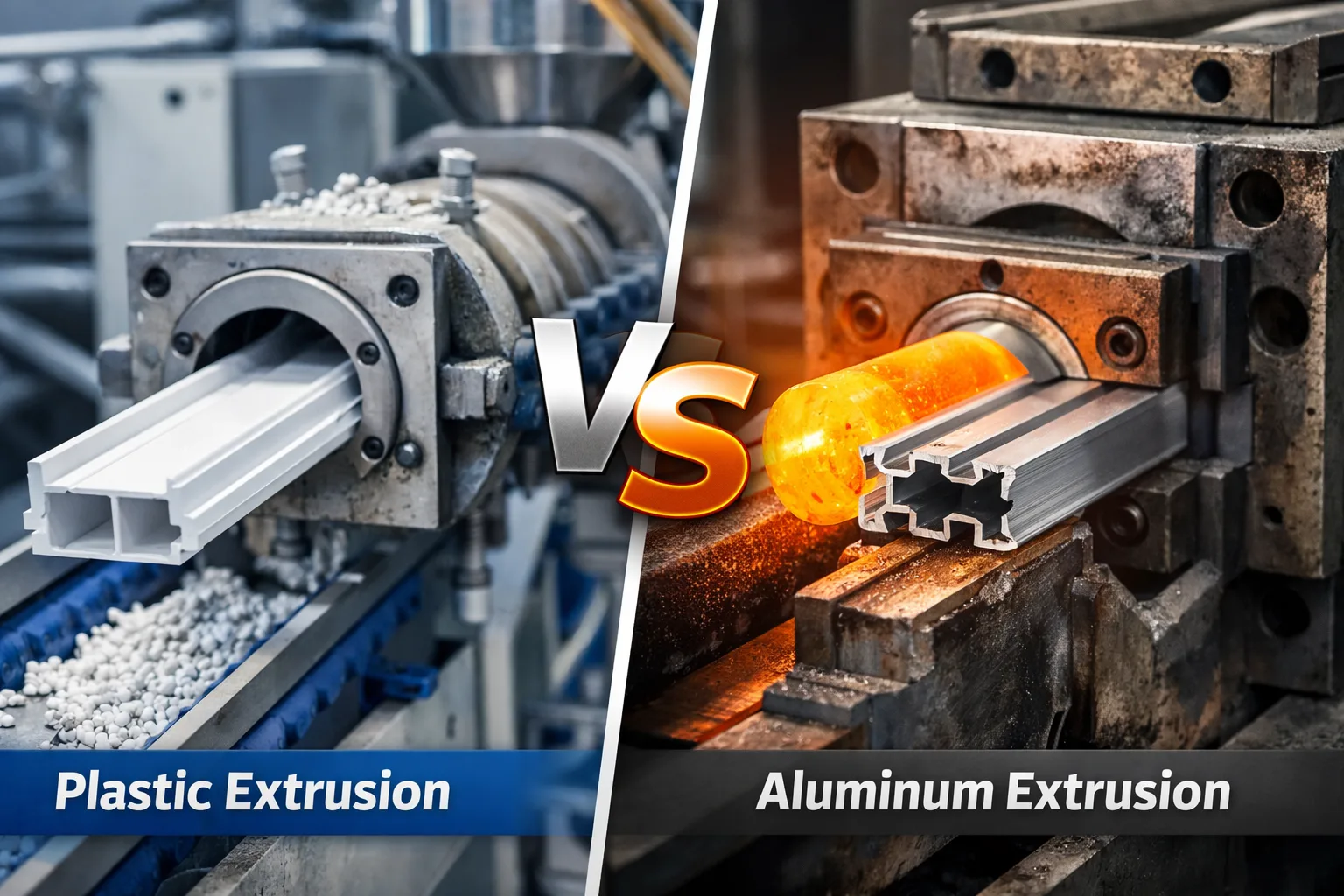
Extrusion manufacturing is widely used for producing continuous profiles with consistent cross-sections. Two primary methods dominate the industry: plastic extrusion and aluminum extrusion.
Choosing the right process depends on structural requirements, environmental conditions, material properties, and cost considerations.
Understanding the differences between these two extrusion processes helps manufacturers and engineers select the most suitable solution for their application.
2. Overview of Plastic Extrusion
Plastic extrusion forms thermoplastic materials into continuous profiles using a heated screw-driven system and precision extrusion dies.
2.1 Common Materials
- PVC extrusion
- ABS extrusion
- PP extrusion
- PE extrusion
- PC extrusion
2.2 Key Advantages
- Lightweight material
- Excellent corrosion resistance
- Good electrical insulation properties
- Cost-effective mass production
- Suitable for complex profile designs
2.3 Typical Applications
- Industrial plastic profiles
- Construction trims
- Cable management systems
- Consumer electronics housings
- Medical device support components
Plastic extrusion is ideal when structural load requirements are moderate and corrosion resistance is important.
3. Overview of Aluminum Extrusion
Aluminum extrusion involves heating aluminum billets such as 6063 or 6061 alloys and pushing them through precision dies under high pressure.
3.1 Common Materials
- Aluminum 6063 extrusion
- Aluminum 6061 extrusion
- Custom aluminum alloys
3.2 Key Advantages
- High strength-to-weight ratio
- Excellent dimensional stability
- Strong structural performance
- Long service life
- Compatible with surface finishing methods
3.3 Surface Finishing Options
- Anodizing
- Powder coating
- Electrophoresis
- Polishing
Aluminum extrusion is preferred for load-bearing structural profiles and automation systems.
4. Key Differences Between Plastic and Aluminum Extrusion
| Factor | Plastic Extrusion | Aluminum Extrusion |
|---|---|---|
| Structural Strength | Moderate | High |
| Weight | Very Lightweight | Lightweight with high strength |
| Corrosion Resistance | Excellent | Excellent (with finishing) |
| Cost | Lower material cost | Higher material cost |
| Structural Load Capacity | Limited | Suitable for heavy loads |
| Surface Options | Matte, textured, coated | Anodized, powder coated |
5. When to Choose Plastic Extrusion
Plastic extrusion is recommended when:
- Lightweight profiles are required
- Electrical insulation is necessary
- Corrosion resistance is critical
- Cost efficiency is a priority
- Structural loads are moderate
It is commonly used in industrial plastic profiles and consumer electronics applications.
6. When to Choose Aluminum Extrusion
Aluminum extrusion is suitable when:
- Structural strength is required
- High dimensional stability is critical
- Long-term mechanical durability is needed
- Modular automation systems are used
- Complex structural cross-sections are necessary
It is widely used in industrial equipment profiles and automation systems.
7. Role of Process Stability and Die Design
Regardless of material, extrusion manufacturing quality depends on:
- Die design optimization
- Temperature control
- Balanced material flow
- Standardized production procedures
- Dimensional control systems
Process stability ensures high consistency production and reliable performance across large batches.
8. Integration with Secondary Processing
Both plastic and aluminum extrusion often require:
- Cutting
- Drilling
- Tapping
- CNC machining
- Surface finishing
Integrated secondary processing improves assembly compatibility and reduces production time.
9. Conclusion
Both plastic extrusion and aluminum extrusion offer valuable manufacturing solutions. The correct choice depends on mechanical requirements, environmental conditions, cost structure, and product design.
Precision extrusion manufacturing, supported by die design optimization and process stability, ensures high consistency production for industrial equipment, construction systems, electronics, and medical applications.