

1. Introduction
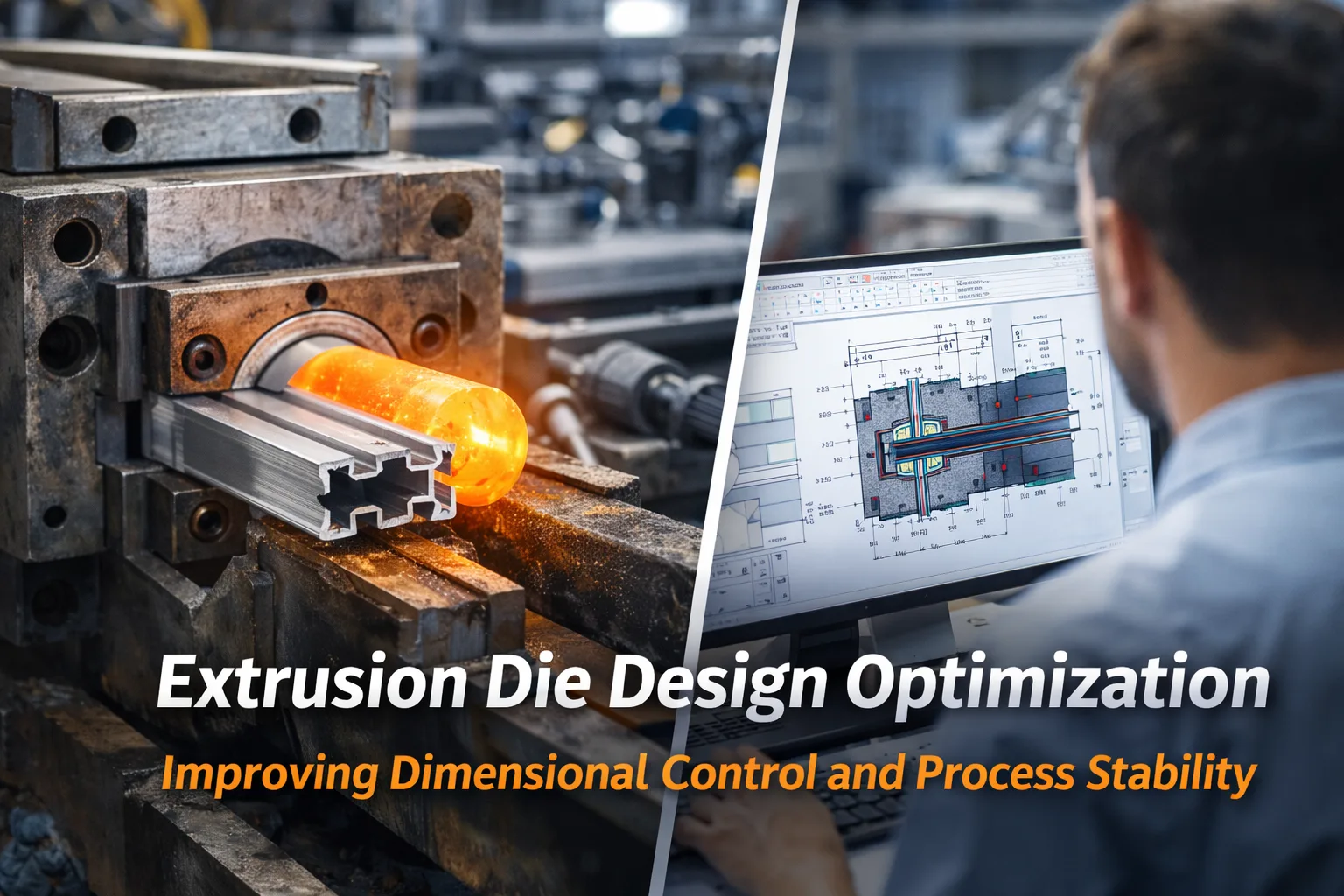
In extrusion manufacturing, the extrusion die is the core component that defines profile shape, dimensional accuracy, and surface quality. Whether in plastic extrusion or aluminum extrusion, die design optimization plays a critical role in ensuring process stability and consistent production results.
A well-designed extrusion die ensures balanced material flow, reduced internal stress, and improved dimensional control.
2. What is an Extrusion Die?
An extrusion die is a precision-engineered tool that shapes heated material into a continuous profile with a fixed cross-section.
In plastic extrusion, the die controls:
- Melt flow direction
- Wall thickness distribution
- Surface finish consistency
In aluminum extrusion, the die controls:
- Material deformation under high pressure
- Structural geometry
- Mechanical performance consistency
The die directly determines the final profile quality.
3. Common Problems Caused by Poor Die Design
Improper die design can lead to:
- Uneven wall thickness
- Profile warping
- Surface defects
- Dimensional deviation
- Increased scrap rate
- Higher secondary processing cost
These issues reduce production efficiency and affect long-term product reliability.
4. Key Factors in Die Design Optimization
4.1 Balanced Material Flow
Uniform flow distribution ensures stable cross-sections and reduces internal stress.
4.2 Thermal Control
Proper temperature management prevents material degradation and ensures consistent forming.
4.3 Structural Reinforcement
Die structure must withstand pressure in aluminum extrusion and continuous operation in plastic extrusion.
4.4 Precision Machining
High-precision die manufacturing improves dimensional control and surface finishing quality.
5. Impact on Process Stability
Optimized die design improves:
- Batch-to-batch consistency
- Production repeatability
- Reduced material waste
- Improved surface quality
- Higher production efficiency
Process stability is essential in industrial equipment profiles, automation frames, and medical device components where dimensional control is critical.
6. Relationship Between Die Design and Secondary Processing
When extrusion dies are properly optimized:
- Less post-machining is required
- Surface finishing becomes easier
- Assembly compatibility improves
- Lead time is reduced
Integrated die optimization reduces overall manufacturing cost while improving quality.
7. Application in Plastic and Aluminum Extrusion
Plastic Extrusion
Optimized die geometry ensures:
- Stable PVC, ABS, PP, PE, and PC extrusion
- Uniform cooling performance
- Long-length dimensional consistency
Aluminum Extrusion
In aluminum 6063 and 6061 extrusion:
- Pressure distribution must be controlled
- Complex cross-sections require flow balance
- Structural strength depends on precise geometry
Die optimization directly supports high consistency production.
8. Engineering Support and Continuous Improvement
Professional extrusion manufacturing requires:
- CAD-based die simulation
- Material flow analysis
- Continuous process monitoring
- Quality inspection systems
Engineering-driven die design ensures extrusion manufacturing remains stable and scalable.
9. Conclusion
Die design optimization is fundamental to precision extrusion manufacturing. It directly influences dimensional control, process stability, surface quality, and production efficiency.
Whether in plastic extrusion or aluminum extrusion, investing in die design engineering ensures reliable, repeatable, and high-quality profile manufacturing for industrial equipment, construction systems, electronics, and medical applications.